Diesen Artikel fand ich bei stud.uni-hannover.de/%7Emheine/
... leider nur in English!
Eine freie Übersetzung findet Ihr hier.
Eine weitere deutsche Kurzfassung findet Ihr hier.
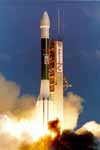 |
HDelta II rocket |
"The Secret in Hanger AE"
by Bob Castro.
March 6, 1999
Amiga owners know their machines can do a lot with a
little. Because
of its flexible
and integrated video-friendly hardware as well as its tight, efficient multi-tasking
operating system, Amigas can be found doing things such as driving stadium score-
boards,
interactive kiosks, agricultural irrigation systems and the flight schedule
displays at Atlanta's Hartsfield International Airport.
The Amiga was chosen for those applications because its reliable hardware
and
low-overhead software means less down time for those crucial jobs. But most
Amiga
owners would be suprised to learn just how much their machines' reliability
is trusted
to carry out one of the toughest jobs in the world- or off of it.
For more than a dozen years, Amiga computers have been hard at work at
Cape
Canaveral's Hanger AE supporting the launches of every American spacecraft
including the space shuttle.
Since after all, this IS rocket
science, NASA must downlink a tremendous
amount of
data from each spacecraft; during ground tests, through the countdown and
liftoff
and out into space.
There is no room for error in the acquisition and processing of this
data.
It must be accurately calculated and reliably sent from the hanger to distant space
centers around the world participating in the mission. All in real time and without
interruption.
Since Hanger AE also supports some telemetry from the space shuttle, that importance
is even greater since human lives are on the line.
Thanks to the efforts of Space Coast Amiga
member, Hal Greenlee and retired
Air
Force Lieutenant Colonel Johnny Johnson, Amiga Atlanta was allowed an exclusive
television tour of Hanger AE during the flight of the space shuttle Endeavour
to the
Russian MIR space station.
Gary Jones, the principle systems engineer for NASA's software systems
at Cape
Canaveral told us the Amigas take in all the telemetry data from the
spacecraft,
scale it by applying coefficients up to fifth order polynomials and convert the data
back to engineering units for display to the engineers working the
launch.
Gary went on to tell us that their first choice was the Macintosh, but
as it was a
closed system, Apple wouldn't give NASA enough information to get into it at the
level that was needed. Talk about blowing a marketing
opportunity!
He continued "We then looked at the PC, but the hardware architecture
was really
as bad then as it is now. So Hal was the first one who brought out one of the
Amiga
1000's and we played with it."
Hal Greenlee added; "I brought it out and showed it to Dave Brown
and about a
month or two didn't pass before Dave had one of his own. We were both talking
to
Skip, we need to get some of these babies and find out if we can make them work
for
this job."
Gary Jones replied; "And Commodore was easy to work with back
then,
when we
asked for documentation they sent us a stack of documentation about four feet high.
They were willing to tell us everything about their machine. Since we had to
design
some custom hardware to go inside, it really helped to know exactly how everything
worked."
"It just turned out that it was a good
machine. The things that
make a machine good
for playing games tend to make it good for processing and displaying
data. Because
you've got some of the same problems. You need an operating system that
very
efficient, very fast and the Amiga has that and has got very little
overhead.
That's
what makes it nice; we don't load down the system running the overhead we can
just process the data."
"Most of our customizing is hardware
customizing. The Amiga operating
system is
flexible enough we have to drop into assembly only once in a while to initialize
some
of the special boards we use, but otherwise the operating system is fine we
don't do
anything unusual with it. We use it just like it is and build hardware for
our interfacing
requirements because we have to pull the data out of the data bus in this
building
and put the data back in."
Seven Amigas are online assigned to operational
support, six are dedicated
to
routing data to remote space centers and another six are reserved for hardware
and
software development.
The spacecraft supported by the Amigas include; all of the
Atlas-Centaurs,
Delta II
and Delta III, the Orbital Sciences Pegasus, Lockheed-Martin Athena, a couple
different models of the Titan, GOES and GPS spacecraft data and some user data
off
the space shuttle.
Because of way the Amiga is laid out and because the software is all tied
together,
if the bit rate isn't too high, they can actually support more than one spacecraft
at
a time in the same Amiga. A multi-tasking, multi-spacecraft personal
computer!
Even though the Amigas play an important role in handling
telemetry, they
are
versatile enough to interface with other NASA computers. Augie Friscia of Boeing
Aerospace
told us; "I figured out a way of transferring files from the Amiga to
a
Sun by converting the source files I had on the Amiga to an archive and then
transferring them
to a Sun machine. With just a few minor adjustments to the top
of the program and
the declare statements, I could compile and run it on the Sun.
I did all the debugging
on the Amiga and then took it to the Sun."
Gary Jones; "If its not a PC, NASA gives us a lot of grief when we
try to buy anything
to go with the Amigas. They want us to buy PC's and run Windows 95 and NT.
We keep trying to tell them its not fast enough so they tell us to buy DEC Alphas.
We tell them its too expensive. They don't like the Amiga, it doesn't cost
enough."
During our January 1998 visit to Hanger AE, the space shuttle Endeavour
had just
finished retrieving David Wolff from the Russian Mir space
station.
Gary Jones; "This is data coming down from the shuttle the STS-89
flight that was
docked with the MIR up until yesterday. This is some of the environmental
parameters that the life sciences people use. They take this data, we process it
with
the Amiga, we remote it to them on another Amiga which then pulls up data
and sends it
to their PC which controls an environmental chamber so that they can
duplicate the environmental
conditions on the shuttle down here except for gravity.
So that's their
control group. They can have a group of animals or insects on the
shuttle in zero G and
the same animals in the same environmental conditions with
normal G about five hangers
down the road from here. And the Amiga data is what
they use to control their
growth chamber to keep the environment the same."
In the NASA Amigas, custom interface hardware is built and used
inside.
But the
most important difference between their Amigas and ours is on the
outside. An
armor-plated power button was built out of a 23-pin video connector because the
engineers
were concerned that the crucial switch was just a little too exposed on
the front
of the Amiga case!
To prove how useful even stock Amigas can be, we found out that although
the
4000's have Workbench 3.1, the 2000's are still running 2.1 because the advantages
of the newer operating system were not really needed.
Even after seeing Amigas hard at work in the telemetry lab, another surprise
was
found in the television center. Hal Greenlee; "We have a toaster system.
We add
titles during the launch. We might do an effect or two just by way of making the
tape
look more interesting. But mainly the Toaster is used to overlay time or camera
angle;
some kind of text data that they want to add to the picture."
Three hundred video monitors are fed by a routing system large enough
to run a
ommercial TV network. In addition to video, it can also route data over
the entire
space center.
Future plans for the NASA Amigas include supporting another model of the
Titan
rocket. They are also in the process of writing software for the next generation
Delta rocket called the Delta III. The American Atlas-Centaur rocket is scheduled
to
have Russian engines installed onboard that will also need new Amiga telemetry
software.
Gary's team will also build a new display capability for the users that will
be
driven by the Amiga. "We'll send them the data over an Ethernet system, and
they'll
use PC's just to do displays."
Although not as easy to purchase and support as other
microcomputers,
Gary
remained
cautious about Gateway's purchase of the Amiga platform.
"We've gotten a little feedback from Hal on Gateway's purchase of
the Amiga. If we
start seeing that they're shipping some hardware we'll get interested then.
But it's
an uphill battle trying to convince NASA that they want to go with something
other
than one of the standard, accepted platforms."
So the next time you see a space shuttle launch, you can tell your friends
which
personal computer is rated for mission-critical use in the United States
space
program.
Note: This article was based on a ten minute videotape taken during Amiga
Atlanta's
visit to Hanger AE. Contact Bob Castro
(bcastro@mindspring.com) for details.
Special thanks also go to Amiga Atlanta member Mike Ellenberg who grabbed
the still
frames from the video you see below.
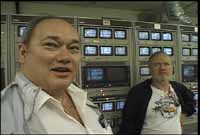 |
Gary Jones (Left) and Hal Greenlee (Right) in Hanger AE, Cape Canaveral Air Station |
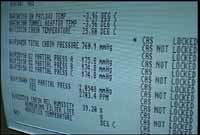 |
Amiga screen displays live user data from the orbiting space shuttle! |
 |
Amiga screen reads "Hanger AE presents the Magic of Amiga" right above data from orbiting space shuttle. |
 |
Amiga 4000 development system. |
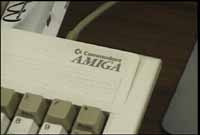 |
Amiga logo on A4000 keyboard in a NASA facility! |
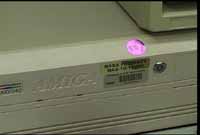 |
A NASA Amiga 4000 good enough for rocket science! |
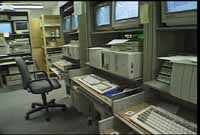 |
Amiga 4000's photographed at work during Jan. 1998 shuttle mission to Russian Mir. |
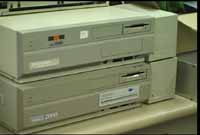 |
Amiga 2000 workhorses in development lab. |
 |
Hanger AE Telemetry lab during shuttle mission. |
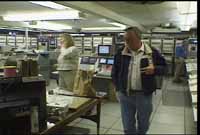 |
Hanger AE Telemetry lab receives and processes vital information on booster rocket and spacecraft health and performance. |
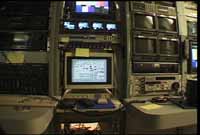 |
Hanger AE Video Toaster system. |
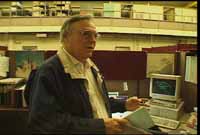 |
A. Friscia of Boeing Aerospace explains how data can be transferred from Amigas to Sun workstations. |
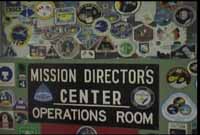 |
Hanger AE Mission Director's Center. The control room where various unmanned spacecraft are launched from Cape Canaveral, Florida. |
 |
In addition to telemetry, Hanger AE also does pre-flight processing of some NASA spacecraft such as the Gamma Ray Observatory. |
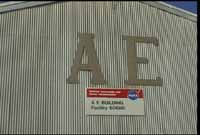 |
Hanger AE building exterior. |
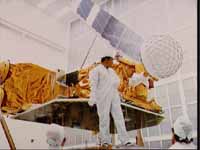 |
Gamma Ray Observatory spacecraft undergoing pre-flight checkout in Hanger AE. In the next room are the NASA Amiga computers. |